Custom Golf Cart Builds in North Georgia
Golf carts in North Georgia rarely stay stock. I build and upgrade carts out of Canton, GA. Street-ready, off-road-capable, or somewhere in between. The goal is a cart that actually gets used, not a parking-lot show piece that won't climb a driveway.
Everything is spec'd as a system: voltage, motor, controller, wiring, and brakes that match each other, because that's the difference between a build that lasts and a pile of parts that fights itself.
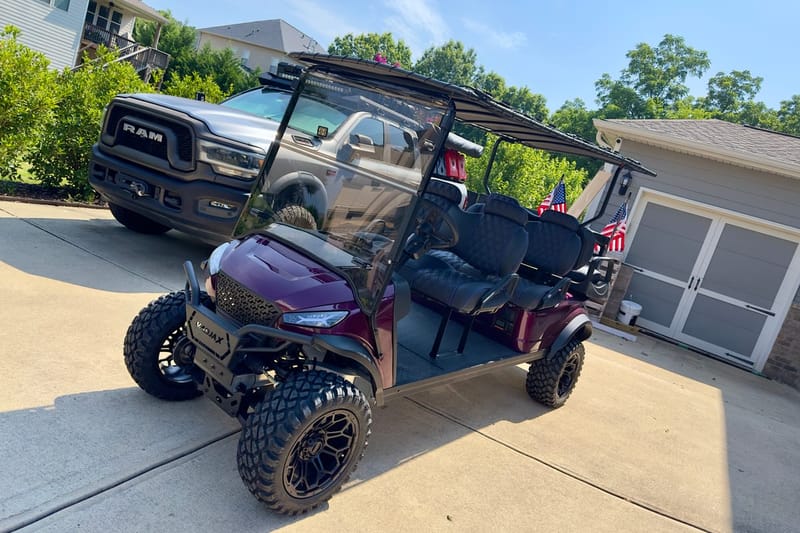
Upgrades that survive actual use.
Lift, wheels & suspension
- 3 to 6 inch spindle, A-arm, and long-travel lifts
- 12 to 15 inch wheels, all-terrain or street tires
- Heavy-duty springs and shocks
- Brakes scaled to the bigger rolling mass
Power & speed
- High-torque and high-speed motor swaps
- Controller upgrades with heavy-gauge wiring
- Hill torque tuned for North Georgia terrain
- Programmable speed limits for street compliance
Lithium conversions
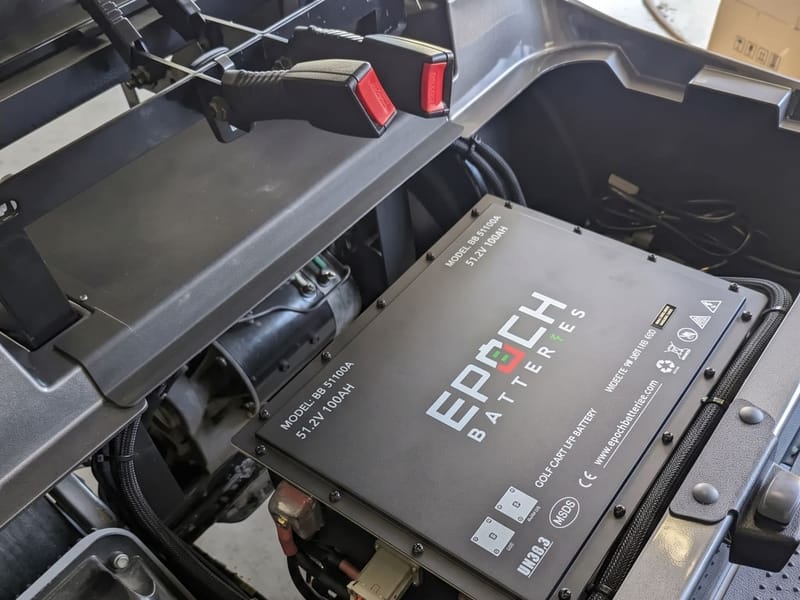
- 48V and 72V LiFePO4 packs with a real BMS
- Matched smart chargers, old charger retired
- Tray cleanup and corrosion repair included
- Roughly 300 pounds lighter than lead-acid
Audio & lighting
- Marine-grade soundbars, amps, and speakers
- Light bars and full street-light packages
- Underglow and accent lighting
- Fused, loomed, weather-sealed circuits
Comfort & utility
- Seat upgrades and rear flip seats
- Enclosures, tops, and windshields
- Cargo beds, racks, and property-work accessories
- Body prep, color, and wraps
Street-ready packages
- PTV checklists for Canton, Cherokee, Forsyth, and beyond
- Lights, mirrors, horn, hip restraints, seat belts
- Speed programmed to the legal spec
- Documentation ready for your registration affidavit
Half the weight. A fraction of the maintenance.
A lead-acid pack is 300 to 400 pounds of batteries that want watering every month, take all night to charge, and quit for good after three to five years. A quality lithium conversion changes the whole character of the cart.
- Massively lighter. Around 300 pounds off the cart means better range, quicker acceleration, and less suspension wear.
- Years, not seasons. Thousands of charge cycles versus several hundred for lead-acid. It usually pays for itself at the first skipped battery replacement.
- Charges in 1-3 hours. Instead of 8 to 14. Plug in at lunch, drive by dinner.
- Zero watering. No terminals to clean, no acid, no monthly ritual. A real BMS and a matched charger keep the pack safe.
Built to pass your city's checklist.
Georgia leaves golf cart rules to cities and counties, so every North Georgia town runs its own registration — Canton, Woodstock, Cherokee, Forsyth, and the rest each with an equipment affidavit: brakes, lights, reflectors, mirror, horn, hip restraints, and a speed cap of under 20 mph for a street-legal PTV.
I build to your city's exact checklist, program the speed to spec, and hand you documentation that makes the registration affidavit easy. And if someone promises you a 30 mph cart that's also street legal, they're skipping a chapter of state law that I won't.

From first call to finished work.
Goals & budget
How the cart will actually be used: neighborhood, trail, or property work. Who drives it, where you live, and a realistic budget band.
Spec & quote
I inspect the donor cart (frame, brakes, batteries, wiring) and spec a matched system with a written quote. No surprise add-ons.
Build
Heavy-gauge cabling, torque-checked connections, fused accessory circuits, and brakes and suspension sized to the new speed and weight.
Shakedown & handoff
Test drive under load and on hills, charge cycle verified, speed programmed for compliance, and a walkthrough of operation and care.
Frequently asked questions
How fast can a golf cart go?
Stock electric carts run about 12-15 mph. Upgraded 48V builds reach the low-to-mid 20s and 72V builds can pass 30. Keep in mind that in Georgia a cart capable of more than 20 mph stops being a street-legal PTV, so I can build for speed and program limits for compliance, whichever you actually need.
Can I drive the cart on public roads after you build it?
In most North Georgia communities, yes, as a PTV: under 20 mph, required safety equipment, and a local registration decal (about $15) for approved low-speed streets. Your city or county — Canton, Woodstock, Cherokee, Forsyth, and the rest — each have their own checklist and process. I build to your city's spec and hand you the documentation; the registration itself is on you, and it's worth verifying current rules with your city.
Is a lithium battery conversion worth it?
Usually yes if you'll keep the cart a few years. It costs more upfront than lead-acid but delivers several times the cycle life, cuts about 300 pounds, charges in 1-3 hours, and never needs watering. Per year of ownership it's typically the cheaper battery.
What's the difference between 36V, 48V, and 72V?
Voltage sets the performance ceiling: 36V is a 12-14 mph cart, 48V supports strong 20-25 mph builds, and 72V delivers the best speed and hill torque. A voltage conversion is not just a battery swap though; the controller, wiring, solenoid, and charger all have to match.
What will a controller or motor upgrade actually do?
A higher-amp controller gives more torque: better hills, better acceleration, less bogging with passengers. Top speed comes from motor RPM and voltage, not the controller alone. That's why I spec them together instead of stacking parts.
Can you upgrade a cart someone else built?
Yes. Add-on work like audio, lighting, and controller upgrades is common, and so is straightening out wiring from a previous build. Most "cart randomly dies" complaints trace to wiring, not batteries.
What maintenance does an upgraded cart need?
With lithium, almost none on the batteries: just tires, brakes, and an occasional connection check. Lead-acid needs monthly watering and terminal cleaning. Lifted carts should get periodic lug and alignment checks, which I'm happy to do as an annual once-over.
Based in Canton, GA, building carts across North Georgia and the greater Atlanta metro — Woodstock, Alpharetta, Marietta, Gainesville, Cartersville, and anywhere within about an hour.